Private Mortgage Insurance: What It Is and How Home Equity Can Affect ItIf you bought your home with a conventional mortgage and put less than 20% down, you may still be paying private mortgage

Dated: September 2 2026
Views: 45
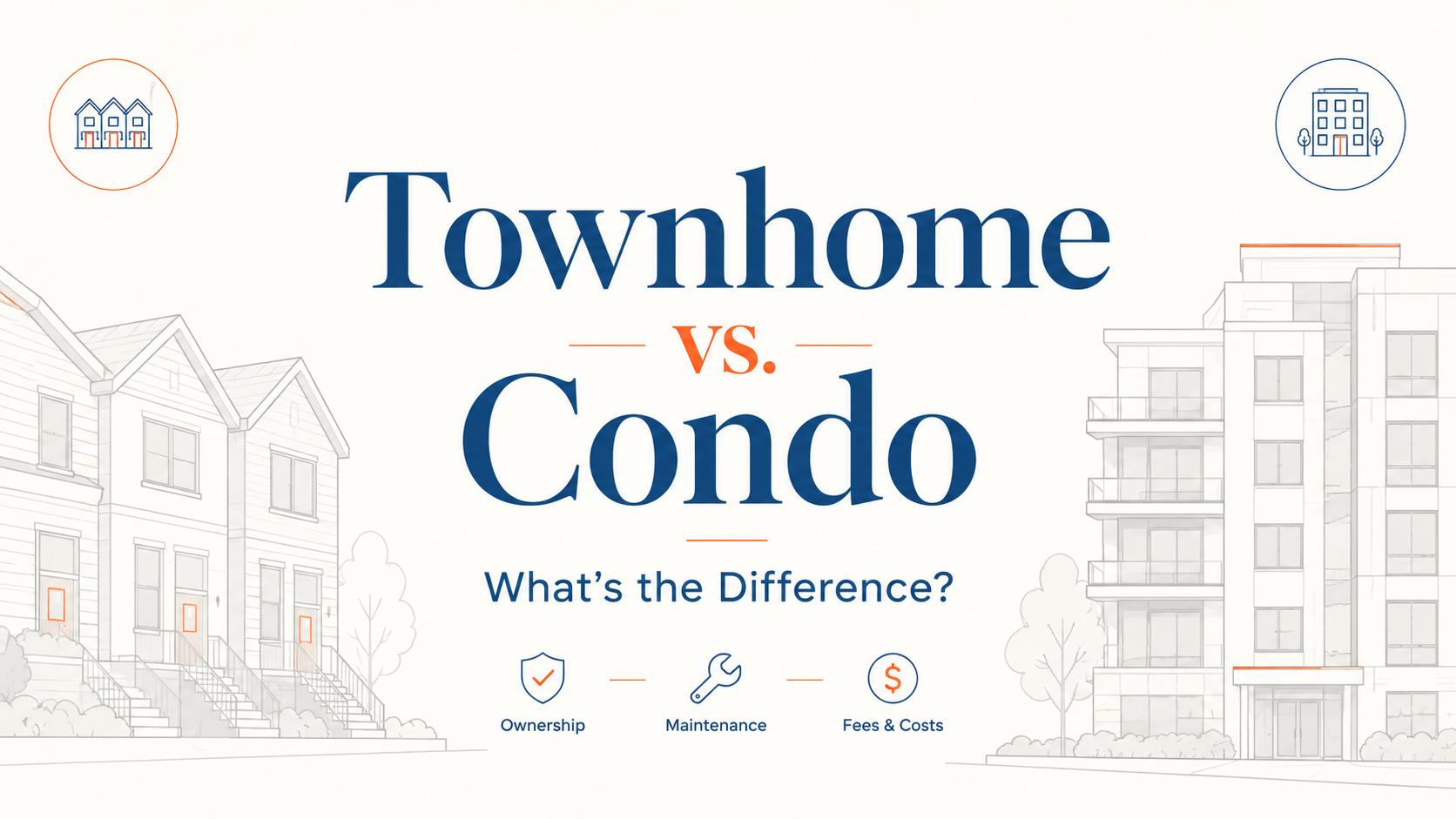 Townhome vs. Condo: What’s the Difference for Home Buyers?
Townhome or condo?
If you’re looking at attached homes in Bryan-College Station, you’ll probably see both terms. And from the curb, the difference may not be obvious at all.
That’s because townhome generally describes the type of home you’re looking at, while condominium describes how a property is legally organized and owned.
Understanding that distinction matters because it can affect what you own, what you’re responsible for maintaining, how the property is insured, and sometimes how easily it can be financed.
A townhome, or townhouse, describes a type of attached residential construction.
Texas law defines a townhouse, in one context, as a single-family dwelling constructed as part of a group of attached units, with each unit extending from the foundation to the roof.
In everyday real estate terms, townhomes commonly have their own entrance, share at least one wall with another home, and often have multiple stories.
But here's the important part:
The word “townhome” by itself doesn't necessarily tell you how the property is legally owned.
A townhouse may be individually owned along with the land associated with it, or a townhouse-style property can be part of a condominium regime.
A condominium is a form of real property ownership.
Under the Texas Uniform Condominium Act, portions of the property are designated for separate ownership while other portions are designated for common ownership by the unit owners.
In simple terms, you own your individual condo unit along with an ownership interest in the condominium's common elements.
Those common elements might include things such as roofs, exterior areas, landscaping, parking areas, private streets, recreational amenities, or portions of the building.
Exactly what belongs to the individual unit and what belongs to the common elements is established in the condominium declaration.
And this is where the distinction gets interesting:
A property can physically look like a townhouse but legally be a condominium.
You can't always determine the ownership structure by looking at the building.
This is probably the most important question to ask when comparing the two.
With an individually platted townhome that is not legally organized as a condominium, you may own the home itself and the lot it sits on, similar to other individually owned residential property.
With a condominium, you own the unit defined in the condominium documents plus an allocated interest in the common elements.
That distinction can determine whether something like the roof, exterior walls, yard, driveway, or other areas is your responsibility or the association's.
And you shouldn't assume.
Two communities that look remarkably similar can divide those responsibilities very differently.
Both townhomes and condominiums can have associations and monthly or annual assessments.
Instead of only asking:
“How much is the HOA?”
We think buyers should also ask:
“What does the HOA actually cover?”
One community might maintain landscaping and common areas but leave individual homeowners responsible for their roofs and exteriors.
Another might have the association responsible for significantly more of the property's exterior and common elements.
A higher association fee isn't automatically good or bad. You have to understand what you're getting for that fee and what expenses will still fall to you as the owner.
Insurance is another reason the legal structure matters.
Texas condominium law generally requires a condominium association to maintain certain property insurance on insurable common elements, along with liability coverage. Depending on the way the condominium is structured, association coverage may extend further.
That doesn't necessarily mean the individual condo owner doesn't need their own insurance.
Owners may still need coverage for their unit, personal property, liability, improvements, deductibles, or other items not covered by the association's master policy.
An individually owned townhome may be insured more like other individually owned residential property.
Either way, buyers should understand both the association's coverage and the insurance they will need personally before closing.
For many home purchases, the lender is primarily evaluating the borrower and the property.
With a condominium, the project itself can also become part of the lending review.
For example, Fannie Mae has specific eligibility and review requirements for many condominium projects. Depending on the project and transaction, lenders may review factors involving the condominium association, project completion, insurance, finances, ownership and other project characteristics.
Not every condo requires the same level of project review, but it is enough of a difference that buyers should identify a condominium early in the process and talk with their lender about financing.
That can be particularly important if you're comparing several townhome-style properties and one is legally a condo while another isn't.
This is especially relevant in Bryan-College Station.
We regularly have buyers who are considering a property for a Texas A&M or Blinn student, as an investment property, or as a home they may eventually turn into a rental.
Whether you're buying a condo or townhome, don't assume renting is automatically allowed under whatever terms you choose.
Association and governing documents may contain rules involving leases, minimum lease periods, short-term rentals, tenant registration, parking, pets, occupancy, or other property uses.
The restrictions vary by community, so this is another area where reviewing the actual documents matters more than relying on the property label.
Neither is automatically better.
A buyer who wants an attached home but also wants more individual control over the property may prefer one ownership structure.
Someone who wants certain exterior or common-area responsibilities handled collectively may prefer another.
What matters is understanding what you're buying before deciding whether it fits you.
When comparing properties, look beyond “townhome” or “condo” and ask:
The biggest takeaway is simple:
Townhome describes the home. Condo describes a legal form of ownership. They aren't opposite categories.
A townhouse-style home can potentially be part of a condominium, which is why the property's legal documents matter more than what it looks like from the street.
At NextHome Realty Solutions BCS, we help buyers look beyond the basic listing information and understand the questions that need to be answered before purchasing.
If you're comparing a condo, townhome, or another type of property in Bryan, College Station, or elsewhere in the Brazos Valley, reach out to Amber Romitelli. We can help you work through the differences and determine what fits your plans.
🏠 Here to help you find your happy place! 🧡
Amber Romitelli | REALTOR®
NextHome Realty Solutions BCS
Sources
Texas Property Code, Chapter 82: Uniform Condominium Act
Texas Property Code, Chapter 27: Residential Construction Liability
Fannie Mae Selling Guide: Project Standards

Amber Romitelli is a REALTOR® with NextHome Realty Solutions BCS, serving buyers and sellers across Bryan-College Station, TX. She is part of the #1 NextHome office in Texas and the #9 NextHome offic....
Private Mortgage Insurance: What It Is and How Home Equity Can Affect ItIf you bought your home with a conventional mortgage and put less than 20% down, you may still be paying private mortgage
Planning for Fall 2027 Aggie Housing? It’s Earlier Than You ThinkIf your student is planning to attend Texas A&M in Fall 2027, housing may feel like something you can deal with next spring
The Rooms Buyers Fall in Love With FirstYou can walk through ten houses in one afternoon and remember each one for a completely different reason.One might have the kitchen. Another has a primary
Seller Concessions Explained: Why a Price Reduction Isn’t Always the Best DealWhen buyers and sellers negotiate a home purchase, price tends to get most of the attention. But sometimes the
 © 2026 Bryan College Station Regional Association of Realtors. All rights reserved. Information deemed to be reliable but not guaranteed. The data relating to real estate for sale on this website comes in part from the Broker Reciprocitysm Program. Real estate listings held by brokerage firms other than NextHome Realty Solutions BCS are marked with the BR logo and detailed information about them includes the name of the listing brokers. Listing broker has attempted to offer accurate data, but
buyers are advised to confirm all items. Information last updated on September 21, 2026 11:42 PM UTC
Show More...
© 2026 Bryan College Station Regional Association of Realtors. All rights reserved. Information deemed to be reliable but not guaranteed. The data relating to real estate for sale on this website comes in part from the Broker Reciprocitysm Program. Real estate listings held by brokerage firms other than NextHome Realty Solutions BCS are marked with the BR logo and detailed information about them includes the name of the listing brokers. Listing broker has attempted to offer accurate data, but
buyers are advised to confirm all items. Information last updated on September 21, 2026 11:42 PM UTC
Show More...
